The new school year for 2009 in Australia.
Children traipse off to school this week, some yesterday, some today, some tomorrow.
For homeschoolers, the start of a new school year can mean time for planning. To organise curriculum and schedules.
Beverley Paine has many articles on getting started, organising your day, managing clutter, writing your own curriculum...
For unschoolers, life kinda just continues. We do a bit here and a bit there, we read, we watch movies, we talk...Our term time activities start up again and my Kumon gets busier but the essentials remain the same.
Last year, on the official first day of school we had a Not Back To School Day ~ went to the city, to Borders, met a son for lunch at an Italian restaurant....
What are we doing today? I had breakfast at Borders with some ladies from church, kids looked at Borders and shops; came home, did some Maths, I did Kumon, they did some writing, played computer, watchng TV now while I blog..Then work at Kumon this afternoon.
Gee, Borders features a lot in our unschooling. Borders unschooling? A school day at Borders?
So, if you are intrigued , if you are interested in unschooling this year, if you don't want to go the organisation and curriculum routine, what do you do? You can read our Unschooling Catholics blog. Especially the post on Beginning Unschooling.
Showing posts sorted by relevance for query new school year. Sort by date Show all posts
Showing posts sorted by relevance for query new school year. Sort by date Show all posts
Thursday, January 29, 2009


Thursday, January 14, 2010
As we approach the new school year
The Anti-Planning Post.
As we approach the start of term one here in Australia, many homeschoolers naturally turn to thoughts about what-to-do-this-new-year.

For us, this is somewhat easy, as we never really stop or start homeschooling. As you can see from this week's homeschool log.
And from pics. Kids here..reading at the airport...journal writing while on holiday...taking their Kumon bag on holiday...
But I still like to think about our rhythms and things we may like to tweak.
With my general busyness, with work and volunteer stuff and study, I also need to see, mentally, and then written in my journal, how a week could look. Will I find time to be there for my kids, amidst housework and paid work and everything-else?
Well, I make sure I will, by glancing over my week.
The monthly bulletin board is a boon for us...we put up pics or info about the saints for the month, birth days, happenings.
I keep the saints calendar book open, for info about the Saint of the Day and artwork.
I am thinking we may go back to refrigerator strewing ~ each month putting stuff up about an artist for that month, and/or French/Latin mottoes for that month.

So, as we Australian homeschoolers approach the new school year, can I suggest that we look less at curricula and more at rhythms? At creating a lifestyle of learning.
Read Julie Bogart's Bravewriter One Thing ..and how it helped with our plans in January 2006.
I am feeling a bit under the weather, as they say. Tired, I have a sore throat, blood clots in superficial veins, on rest....So, I am back to my One Thng.One Thing for each day, to be and do with the children. I first heard of the One philosophy when I was a young teenager, reading one of those ubiquitous magazines for young women.The article was called One Bowl and was a dieting article - describing the philosophy of paring back. The ideas was to eat all one's meals out of one small bowl - thus cutting down automatically on portions. And learning to savour meals from the One Bowl. Since then, I have read about the One philosophy applied to many areas. I have tried to keep to One Thing at many times, when everything else seems like too much. One Thing can also be applied to housework, to habits, to homeschooling or unschooling......
So, what was my One Thing for unschooling yesterday? Typically me, the One Thing was actually Two Things. 1.Read about the Epiphany Blessing and its traditions and meanings 2. Share my writing ideas with the dc - my thought of writing and drawing in our journals, about our holidays with the older three boys. About our dreams and wishes for 2006. Include photos and cut outs from leaflets collected on our visits in the holidays. Paste in snippets of Christmas cards. Pics of goals for the year.
And, as we approach the new school year, with plans, remember to take it easy. Plan for joy. Don't start the year stressed.
If your mind is like mine at the moment, a hotch-potch of worries and problems and issues, start the year with time out.
As we approach the start of term one here in Australia, many homeschoolers naturally turn to thoughts about what-to-do-this-new-year.

For us, this is somewhat easy, as we never really stop or start homeschooling. As you can see from this week's homeschool log.
And from pics. Kids here..reading at the airport...journal writing while on holiday...taking their Kumon bag on holiday...
But I still like to think about our rhythms and things we may like to tweak.
With my general busyness, with work and volunteer stuff and study, I also need to see, mentally, and then written in my journal, how a week could look. Will I find time to be there for my kids, amidst housework and paid work and everything-else?
Well, I make sure I will, by glancing over my week.
The monthly bulletin board is a boon for us...we put up pics or info about the saints for the month, birth
 days, happenings.
I keep the saints calendar book open, for info about the Saint of the Day and artwork.
I am thinking we may go back to refrigerator strewing ~ each month putting stuff up about an artist for that month, and/or French/Latin mottoes for that month.

So, as we Australian homeschoolers approach the new school year, can I suggest that we look less at curricula and more at rhythms? At creating a lifestyle of learning.
Read Julie Bogart's Bravewriter One Thing ..and how it helped with our plans in January 2006.
I am feeling a bit under the weather, as they say. Tired, I have a sore throat, blood clots in superficial veins, on rest....So, I am back to my One Thng.One Thing for each day, to be and do with the children. I first heard of the One philosophy when I was a young teenager, reading one of those ubiquitous magazines for young women.The article was called One Bowl and was a dieting article - describing the philosophy of paring back. The ideas was to eat all one's meals out of one small bowl - thus cutting down automatically on portions. And learning to savour meals from the One Bowl. Since then, I have read about the One philosophy applied to many areas. I have tried to keep to One Thing at many times, when everything else seems like too much. One Thing can also be applied to housework, to habits, to homeschooling or unschooling......
So, what was my One Thing for unschooling yesterday? Typically me, the One Thing was actually Two Things. 1.Read about the Epiphany Blessing and its traditions and meanings 2. Share my writing ideas with the dc - my thought of writing and drawing in our journals, about our holidays with the older three boys. About our dreams and wishes for 2006. Include photos and cut outs from leaflets collected on our visits in the holidays. Paste in snippets of Christmas cards. Pics of goals for the year.
And, as we approach the new school year, with plans, remember to take it easy. Plan for joy. Don't start the year stressed.
If your mind is like mine at the moment, a hotch-potch of worries and problems and issues, start the year with time out.
More from Bravewriter, on homeschooling if things feel tough.
Well, the blog post is actually Homeschooling Through Grief but I think it could also be titled unschooling through worries, busyness, stress, no time, too-much-too-think-about...
Keep your plans loose..remember, in a strewing, caring, interesting household, kids will learn. They are wired to learn.
We tend to do more technology when things are tough for me and, you know, the kids learn anyway. And when things improve, I find it easy to add in things that can eventually take over so much screen time..
From the Bravewriter blog ~
Let them watch crap TV and play computer games. I know, I know. That sounds so cynical. Here’s something I know from experience. Kids learn because that’s what they do. I’ve discovered from having been through a rough year myself that my kids have learned stuff I never taught them from Seinfeld episodes, from reality TV, from music (spending big quantities of time listening to and copying lyrics). Your kids need space to recover too, so let them do some of these “lesser forms of learning” without guilt. Remember the summers of your youth when you vegged out all day watching game shows or old movies? It’s okay. They’ll be okay. A little bit of learning combined with a lot of technology and TV for a period of time (a season) may be the easiest way to recover from such a blow as losing your mother. You’ll all get restless and sick of that lifestyle when your energy revives. You will. Trust it.
Thursday, January 31, 2008
Successful Marriage and Not Back to School
Wednesday was the official Back To School Day for schools here in New South Wales; the start of the new school year.
We had our own Not Back To School celebration ~ we ( Greg, Thomas, Alexander, Anthony and I) drove to the city, went to Borders and other places, met up with Jonathon after his photo shoot, caught the train to St Leonards to meet Luke for lunch. Went to Olios, a yummy Italian restaurant/cafe near Luke's work.
Trying to keep the calories down, but celebration up, I had vegetable risotto and no wine.
Back to the city where some caught a train home and some drove ( we can't all fit in one car any more).
Good day.
While at Borders I read a few women's magazines. Pretty fluffy mind stuff. One, however, had an article on Successful Marriages.
Readers shared their tips for a successful marriage.
The tips were, well, weird. In my not so humble opinion.
Like ~ never have a fight with clothes on ( can you magine it!).
But I got to thinking.This April dh and I will have been marred 29 years . ( Insert gasp. OMG. I am OLD.).
I entered marriage as a pretty young, pretty silly, pretty fun seeking university student, a student with a flippant attitude. Hey, we can divorce if it doesn't work out.
This was my family's experience of marriage. And of divorce.
So, I have often second guessed my vocation.
Was I really called to marriage and, then, to mothering?
Why has our marriage survived, been a success, considering my less-than-serious attitude to the sacrament prior to marriage and my lingering doubts over marriage as my vocation.
I think in part,that it has been laughter, our sense of humour, that has made our marriage a success. Made our marriage last.
Dh and I tend to see the silly side of situations . Like when I nearly died dring labour, having son number 5 and the nurse asked me for a name for the child they thought wouldn't live. Alhough in pain, I laughed and recited, with dh catching the drift, "Alexander; because the labour has been a Terrible Horrible No Good Very Bad Day. " As in the book by Judith Viorst.
Why laugh at a time like that?
Why not?
Have you seen Home Alone 3, where the parents are explaining that they have lost son Kevin again. The police ask if this has happened before. The parents start laughing and talk about losing Kevin at Christmas being a " McAllister family tradition."
The police are not amused.
Every time dh and I see that film, we look at each other and laugh. That comment, that laughter in sometimes inappropriate situations, is so us.
My tip for a successful marriage is laughter.
And don't take yourselves too seriously.
And... I think it's about time I stop questioning my vocation, too. Sure, I suck at many traditional mothering, wifely, housekeepy things. But dh and I have been married nearly 29 years and we and the kids are mostly, usually, funnily happy.
So, this is my vocation after all.
Took me a long time to realise that.
We had our own Not Back To School celebration ~ we ( Greg, Thomas, Alexander, Anthony and I) drove to the city, went to Borders and other places, met up with Jonathon after his photo shoot, caught the train to St Leonards to meet Luke for lunch. Went to Olios, a yummy Italian restaurant/cafe near Luke's work.
Trying to keep the calories down, but celebration up, I had vegetable risotto and no wine.
Back to the city where some caught a train home and some drove ( we can't all fit in one car any more).
Good day.
While at Borders I read a few women's magazines. Pretty fluffy mind stuff. One, however, had an article on Successful Marriages.
Readers shared their tips for a successful marriage.
The tips were, well, weird. In my not so humble opinion.
Like ~ never have a fight with clothes on ( can you magine it!).
But I got to thinking.This April dh and I will have been marred 29 years . ( Insert gasp. OMG. I am OLD.).
I entered marriage as a pretty young, pretty silly, pretty fun seeking university student, a student with a flippant attitude. Hey, we can divorce if it doesn't work out.
This was my family's experience of marriage. And of divorce.
So, I have often second guessed my vocation.
Was I really called to marriage and, then, to mothering?
Why has our marriage survived, been a success, considering my less-than-serious attitude to the sacrament prior to marriage and my lingering doubts over marriage as my vocation.
I think in part,that it has been laughter, our sense of humour, that has made our marriage a success. Made our marriage last.
Dh and I tend to see the silly side of situations . Like when I nearly died dring labour, having son number 5 and the nurse asked me for a name for the child they thought wouldn't live. Alhough in pain, I laughed and recited, with dh catching the drift, "Alexander; because the labour has been a Terrible Horrible No Good Very Bad Day. " As in the book by Judith Viorst.
Why laugh at a time like that?
Why not?
Have you seen Home Alone 3, where the parents are explaining that they have lost son Kevin again. The police ask if this has happened before. The parents start laughing and talk about losing Kevin at Christmas being a " McAllister family tradition."
The police are not amused.
Every time dh and I see that film, we look at each other and laugh. That comment, that laughter in sometimes inappropriate situations, is so us.
My tip for a successful marriage is laughter.
And don't take yourselves too seriously.
And... I think it's about time I stop questioning my vocation, too. Sure, I suck at many traditional mothering, wifely, housekeepy things. But dh and I have been married nearly 29 years and we and the kids are mostly, usually, funnily happy.
So, this is my vocation after all.
Took me a long time to realise that.
Friday, November 05, 2010
Because...Unschooling Q & A

Some recent questions that I have received, about our unschooling homeschooling lifestyle. And some of my replies. Because there is never a new question or a dumb question and because blogging is all about sharing and because this blog reflects my unschooling mentality i.e. sharing bits and pieces.
What do you think are the positives of unschooling?
I guess I see some of the positives of unschooling to be rather nebulous, things like joy and an interest in learning; strong family ties; a sense of identity .Things that can’t always be measured but are with our kids for life – so, there is still that difference, for example, in my older sons, long term unschooling graduates.
In other words, you may not see the fruits of unschooling right now, this very minute, but instead catch glimpses of the fruits but over time. Just like the way our children grow. They seem to be little forever and then, one summer, we notice that they have shot up, their jeans are too short, their shirts too small , and we think, with wonder "How they have grown!" It is the same with unschooling. We worry today about that lazy son. about not enough reading and then, one day, we find a Shakespeare novel under a pillow ( "For night time reading, Mum") and a clean kitchen, cleaned by a son, upon your return from work. Maturity and growth.
Sometimes you don’t see quantifiable things – knowing history or art, for example – but you see, instead, their passions, how much the kids know about their passions – or simply, in the case of one of my sons who has no one passion, just a general happiness, a brightness and an interest in life.
But I see value in a classical education. How can I mesh this ideal with unschooling?
Can you let go of your agenda ( the classical education ) and see where God will take you and your children in learning? I think that is the first step to successful unschooling..no hidden agenda, trusting in a rich home and community experience, in your own influence, in living the Faith, in learning through life. For joy in life and learning, joy in adoring Our Lord, joy in family relationships has to come first, before we even talk about classical education or the tools for learning. We are more open to the goals of the education of "the free man" (to quote Plato and Aristotle) when we are in a healthy environment.
One can also strew a classical education rather than require a classical education. Via books, movies, excursions and outings, music, art, discussion. Living, eating, breathing the classics. Learning Latin or Greek yourself. Learning our prayers in Latin. Learning the Latin in Mass in the Extraordinary Form. Endless family discussions and debate and reference to logic. In other words, using the materials and resources of a classical education within your daily life and home.
One can also educate oneself classically – and then share this with the kids...as you share who you are.
A case in point here. Liturgy is my passion. I don’t teach the kids about liturgy but because I read about it, I blog about it, I talk about it, the kids end up knowing about liturgy. Recently , we had two priests over for a cup of tea. And, as often happens here, of late, we began discussing liturgy. The kids were strong in expressing viewpoints and discussing concepts and ideas – and one son said that this year, liturgy had become something of an interest for him too. Education via osmosis.
I have also found that one can pick just a single subject in which to learn perseverance ...and that academic discipline can be learned by consistently studying one subject formally, rather than "doing school" .... and we can leave the other subjects to life and strewing. Sometimes this single subject discipline has been Latin in our house, sometimes Kumon maths or English, sometimes Religion.
But my son's strength is maths but he is not interested in society and environment .
It helps me not to think of my kids in terms of education ( one son is into history, one doesn’t like writing, ) but in terms of virtues ( patience, prudence, fortitude, and so on ) and in terms of character traits ( friendly, quiet) and who they are right now as people. This kind of thought changes my mindset, away from school, and onto the idea of Charlotte Mason that children are born persons. Thinking of children as persons means we think of who they are and what they need; we encourage and acknowledge their input; we don't see them as blank slates on which to write.
Even at work, I see this in my students. I do not mould them; I work with them and guide and instruct and sometimes discipline. I get to know them as people, first.
So, how do we start unschooling?
My suggestion is to start unschooling by taking a vacation, a holiday – in your home, your suburb, your hometown. Act like you would on vacation – make yummy breakfasts, go for walks, play games, watch movies, cook, build Lego, go to museums and libraries, etc.
Don’t think in terms of education, just in terms of living and spending time - and keep a journal of what you do each day. I recently purchased a lovely 365 journal and I am writing brief notes of what we do, things we talk about and think about. It’s hard not to see learning after awhile.
The other thing we do is just celebrate the liturgical year together – you would be surprised how much fun, how much learning occurs just naturally through celebrating the liturgical year. For example, this week we talked about St Martin de Porres, and Peru and looked for Peruvian dessert recipes. We prayed the De Profundis for All Hallows Eve and had an All Hallows Eve party. We went to mass and learned about the history of All Saints and made Soul Cakes. We prayed for the dead on All Souls Day ( and read about horse racing for our Melbourne Cup lunch !) and we talked about St Charles Borromeo, his influence on Blessed John XXIII and about Milan and made Milanese pizza. Who needs school ? And doing activities like this is a good way to fill in that gap that sometimes seems to happen if you stop school and wonder what to do next, what are our passions, what do we do as unschoolers?
But I panic without school!
I used to read unschooling books or websites or blogs, every day. No kidding, this is what I used to do.. read a little bit of unschooling wisdom every day, to help me keep on track when, perhaps, the rest of the world thought I was crazy or lazy. I would pray, workout, read about unschooling each morning.
So is unschooling like unit studies or thematic units?
Well, in a rabbit trail kind of way. Not a full blown you must complete x and y integrated units method but more like..hey, this looks interesting, let's go....The latter describes our unschooling rabbit trails.
For example, it was Harry Potter week and I suggested we do some Harry Potter reading and movies and related activities from a unit study that I found free online. Last year, we were going on a beach holiday to Wollongong so I used some ideas from a homeschool Science blog re a shell project and we did that together. Last year, or the year before, we did the growing tomatoes thing from the Canadian Space project and the Journey North as a family. Earlier this year, we were into the 1980s because we like 1980s music and movies and we went several times to a back to the 1980s exhibition at the Powerhouse Museum. So, I downloaded some teacher resources from the website and we chose some activities to do .
Then we had our whole Legally Blonde/romantic comedy genre study going...and now are into C.S Lewis: Voyage of the Dawn Treader ( new movie coming out); Mere Christianity; Screwtape Letters. And unit study ideas from a study guide ...integrating subjects in a Choose Your Own Adventure fashion.
Can you see how unschooling flows from life, is life, is learning?
So, unschooling is...
Different for everyone.. we have always been very influenced by natural learning, unschooling, delight directed learning, John Holt. And I have found that each of my sons have grown more into self discipline and into academics and continue this interest and inner motivation at university and work.
Therefore, for us, unschooling has lead to more rigorous academics, to learning how to follow a path, to perseverance.
Friday, December 16, 2005
Endings
Yessterday was the last Teen Group for the year - we went to the beach.
It was a seriously beautiful day. I loved the surf, the lunch on the grassed area was fun and the kids loved swimming and catching up with friends.
Christmas and Advent are always times of endings for us - it is the start of the summer holidays and many regular activities finish.
Some people finish homeschooling, with the aim for children to start school in the new year , at the end of January or beginning of February, when schools resume.
Other people plan to start homeschooling in the new year, so we know the new year will often bring new people to our outings and groups.
So, we are finishng off our Christmas crafts with decorating teddies - well, its mostly the youngest, but he is having a whale of a time and getting suggestions from the others.
Next week, the three youngest fly interstate to spend time with their older brothers. And Alexander will have his braces removed!
At home, it will just be dh, I and Jonathon. Weird having only one child at home!
Everyone returns on the night of the 23rd for Christmas - all nine of us will be home for Christmas.
I am planning on a Father Christmas photo for Christmas Eve.
It was a seriously beautiful day. I loved the surf, the lunch on the grassed area was fun and the kids loved swimming and catching up with friends.
Christmas and Advent are always times of endings for us - it is the start of the summer holidays and many regular activities finish.
Some people finish homeschooling, with the aim for children to start school in the new year , at the end of January or beginning of February, when schools resume.
Other people plan to start homeschooling in the new year, so we know the new year will often bring new people to our outings and groups.
So, we are finishng off our Christmas crafts with decorating teddies - well, its mostly the youngest, but he is having a whale of a time and getting suggestions from the others.
Next week, the three youngest fly interstate to spend time with their older brothers. And Alexander will have his braces removed!
At home, it will just be dh, I and Jonathon. Weird having only one child at home!
Everyone returns on the night of the 23rd for Christmas - all nine of us will be home for Christmas.
I am planning on a Father Christmas photo for Christmas Eve.
Saturday, April 14, 2007
Doin' some thinkin' about homeschoolin'..

Recently, on an email list, some other homeschool mothers and I have discussed an article - Solving the Crisis in Homeschooling.
Now, I don't actually think there is a crisis in homeschooling. Homeschooled young adults grow up, try new things, make different choices - some good and some not so good. They grow and learn and work on their spiritual journeys. They pray. They fall. They succeed.
This is not a crisis .This growth is part of their development.
I think it can be hard for some parents to let go - to realize that their dreams of "the happy family" and of how their kids should turn out are not what God has in mind for their kids. I know my dh has had to work through this - not that he was forcing his ideas onto the boys but I know he never envisaged us living so far away from our older sons.
The article and discussion have encouraged me to analyze homeschooling . A bit.
I have pondered. As a parent of homeschool graduates and of current homeschoolers, I find that a big part of homeschooling/unschooling older kids is the letting go - they make their own choices, good or bad or okay, and we keep up our relationships and prayers.
My older sons make good choices, but, nevertheless, the choices are their own.
There is no one recipe in parenting or in homeschooling - do this and your kids will turn out like xyz. Nuh, doesn't work that way.
And maybe this is a crisis for some parents - they find it hard to accept the differences in their young adult sons and daughters.
Homeschooling is no guarantee of success just as attending traditional schools is no guarantee of success.
The real joy of homeschooling/unschooling for me is getting to know each other and sharing interests. I love it when we sit and talk about movies and books - and laugh a lot together. Right now we are on a Stargate kick, watching an episode nearly every night before bed and talking about the series together..
Yes - I know my kids in a different way because of unschooling - and they know me. But we still have differing opinions about some things! Which is cool - they choose , some times differently to that which I would choose, and that is the beauty of unschooling. Working together and appreciating differences.
Family is important, but it is not our idol and eventually kids go and form their own families ( or perhaps join religious communities). Relationships change. We can't or shouldn't stop this.
However, we each bring our own experiences to this whole parenting/homeschooling thing.
Now, I don't actually think there is a crisis in homeschooling. Homeschooled young adults grow up, try new things, make different choices - some good and some not so good. They grow and learn and work on their spiritual journeys. They pray. They fall. They succeed.
This is not a crisis .This growth is part of their development.
I think it can be hard for some parents to let go - to realize that their dreams of "the happy family" and of how their kids should turn out are not what God has in mind for their kids. I know my dh has had to work through this - not that he was forcing his ideas onto the boys but I know he never envisaged us living so far away from our older sons.
The article and discussion have encouraged me to analyze homeschooling . A bit.
I have pondered. As a parent of homeschool graduates and of current homeschoolers, I find that a big part of homeschooling/unschooling older kids is the letting go - they make their own choices, good or bad or okay, and we keep up our relationships and prayers.
My older sons make good choices, but, nevertheless, the choices are their own.
There is no one recipe in parenting or in homeschooling - do this and your kids will turn out like xyz. Nuh, doesn't work that way.
And maybe this is a crisis for some parents - they find it hard to accept the differences in their young adult sons and daughters.
Homeschooling is no guarantee of success just as attending traditional schools is no guarantee of success.
The real joy of homeschooling/unschooling for me is getting to know each other and sharing interests. I love it when we sit and talk about movies and books - and laugh a lot together. Right now we are on a Stargate kick, watching an episode nearly every night before bed and talking about the series together..
Yes - I know my kids in a different way because of unschooling - and they know me. But we still have differing opinions about some things! Which is cool - they choose , some times differently to that which I would choose, and that is the beauty of unschooling. Working together and appreciating differences.
Family is important, but it is not our idol and eventually kids go and form their own families ( or perhaps join religious communities). Relationships change. We can't or shouldn't stop this.
However, we each bring our own experiences to this whole parenting/homeschooling thing.
And it is interesting to me to see just how much we do influence our children- often by osmosis. I love books, movies, writing. Over the years, I have seen all my sons take on these interests themselves - so they have become family interests.
Dh loves history - and several sons have tapped into this interest.
We don't necessarily make our kids love what we love, we give them room for their interests - but nevertheless, I see our influence as very strong.
All this makes me ponder - why do we homeschool?
For relationship. Relationship with God, with the Church, with each other, with other people and the community, with ideas and books and music and art and...
We do not educate in isolation.
Pope Pius XI wrote, in DIVINI ILLIUS MAGISTRI, ON CHRISTIAN EDUCATION~
5. Indeed never has there been so much discussion about education as nowadays; never have exponents of new pedagogical theories been so numerous, or so many methods and means devised, proposed and debated, not merely to facilitate education, but to create a new system infallibly efficacious, and capable of preparing the present generations for that earthly happiness which they so ardently desire.
6. The reason is that men, created by God to His image and likeness and destined for Him Who is infinite perfection realize today more than ever amid the most exuberant material progress, the insufficiency of earthly goods to produce true happiness either for the individual or for the nations. And hence they feel more keenly in themselves the impulse towards a perfection that is higher, which impulse is implanted in their rational nature by the Creator Himself. This perfection they seek to acquire by means of education. But many of them with, it would seem, too great insistence on the etymological meaning of the word, pretend to draw education out of human nature itself and evolve it by its own unaided powers. Such easily fall into error, because, instead of fixing their gaze on God, first principle and last end of the whole universe, they fall back upon themselves, becoming attached exclusively to passing things of earth; and thus their restlessness will never cease till they direct their attention and their efforts to God, the goal of all perfection,..
The Pope continues ~
5. Indeed never has there been so much discussion about education as nowadays; never have exponents of new pedagogical theories been so numerous, or so many methods and means devised, proposed and debated, not merely to facilitate education, but to create a new system infallibly efficacious, and capable of preparing the present generations for that earthly happiness which they so ardently desire.
6. The reason is that men, created by God to His image and likeness and destined for Him Who is infinite perfection realize today more than ever amid the most exuberant material progress, the insufficiency of earthly goods to produce true happiness either for the individual or for the nations. And hence they feel more keenly in themselves the impulse towards a perfection that is higher, which impulse is implanted in their rational nature by the Creator Himself. This perfection they seek to acquire by means of education. But many of them with, it would seem, too great insistence on the etymological meaning of the word, pretend to draw education out of human nature itself and evolve it by its own unaided powers. Such easily fall into error, because, instead of fixing their gaze on God, first principle and last end of the whole universe, they fall back upon themselves, becoming attached exclusively to passing things of earth; and thus their restlessness will never cease till they direct their attention and their efforts to God, the goal of all perfection,..
The Pope continues ~
10. Now in order that no mistake be made in this work of utmost importance, and in order to conduct it in the best manner possible with the help of God's grace, it is necessary to have a clear and definite idea of Christian education in its essential aspects, viz., who has the mission to educate, who are the subjects to be educated, what are the necessary accompanying circumstances, what is the end and object proper to Christian education according to God's established order in the economy of His Divine Providence.
11. Education is essentially a social and not a mere individual activity. Now there are three necessary societies, distinct from one another and yet harmoniously combined by God, into which man is born: two, namely the family and civil society, belong to the natural order; the third, the Church, to the supernatural order.
12. In the first place comes the family, instituted directly by God for its peculiar purpose, the generation and formation of offspring; for this reason it has priority of nature and therefore of rights over civil society. Nevertheless, the family is an imperfect society, since it has not in itself all the means for its own complete development; whereas civil society is a perfect society, having in itself all the means for its peculiar end, which is the temporal well-being of the community; and so, in this respect, that is, in view of the common good, it has pre-eminence over the family, which finds its own suitable temporal perfection precisely in civil society.
13. The third society, into which man is born when through Baptism he reaches the divine life of grace, is the Church; a society of the supernatural order and of universal extent; a perfect society, because it has in itself all the means required for its own end, which is the eternal salvation of mankind; hence it is supreme in its own domain.
14. Consequently, education which is concerned with man as a whole, individually and socially, in the order of nature and in the order of grace, necessarily belongs to all these three societies, in due proportion, corresponding, according to the disposition of Divine Providence, to the co-ordination of their respecting ends.
(Emphasis added)
I think we homeschoolers can look at our communities and at our church communities, and work together, co-operate with others, in the education of our children. There is a role for others and our families benefit by the sharing of this work , this joy of being both parent and educator.
Pope John Paul II wrote of Christian education in a similar manner, in
FAMILIARIS CONSORTIO, ON THE ROLE OF THE CHRISTIAN FAMILY
IN THE MODERN WORLD ~
36. The task of giving education is rooted in the primary vocation of married couples to participate in God's creative activity: by begetting in love and for love a new person who has within himself or herself the vocation to growth and development, parents by that very fact take on the task of helping that person effectively to live a fully human life. As the Second Vatican Council recalled, "since parents have conferred life on their children, they have a most solemn obligation to educate their offspring. Hence, parents must be acknowledged as the first and foremost educators of their children. Their role as educators is so decisive that scarcely anything can compensate for their failure in it. For it devolves on parents to create a family atmosphere so animated with love and reverence for God and others that a well-rounded personal and social development will be fostered among the children. Hence, the family is the first school of those social virtues which every society needs."(99)
The right and duty of parents to give education is essential, since it is connected with the transmission of human life; it is original and primary with regard to the educational role of others, on account of the uniqueness of the loving relationship between parents and children; and it is irreplaceable and inalienable, and therefore incapable of being entirely delegated to others or usurped by others.
The encyclical continues ~
40. The family is the primary but not the only and exclusive educating community. Man's community aspect itself-both civil and ecclesial-demands and leads to a broader and more articulated activity resulting from well-ordered collaboration between the various agents of education. All these agents are necessary, even though each can and should play its part in accordance with the special competence and contribution proper to itself.(104)
The educational role of the Christian family therefore has a very important place in organic pastoral work. This involves a new form of cooperation between parents and Christian communities, and between the various educational groups and pastors... .
The right of parents to choose an education in conformity with their religious faith must be absolutely guaranteed.
The State and the Church have the obligation to give families all possible aid to enable them to perform their educational role properly. Therefore both the Church and the State must create and foster the institutions and activities that families justly demand, and the aid must be in proportion to the families' needs...
In analyzing our homeschooling, I see the importance of the family, of God, of true Christian education. I also see the need to work with others , including the Church and the civil society.
FAMILIARIS CONSORTIO, ON THE ROLE OF THE CHRISTIAN FAMILY
IN THE MODERN WORLD ~
36. The task of giving education is rooted in the primary vocation of married couples to participate in God's creative activity: by begetting in love and for love a new person who has within himself or herself the vocation to growth and development, parents by that very fact take on the task of helping that person effectively to live a fully human life. As the Second Vatican Council recalled, "since parents have conferred life on their children, they have a most solemn obligation to educate their offspring. Hence, parents must be acknowledged as the first and foremost educators of their children. Their role as educators is so decisive that scarcely anything can compensate for their failure in it. For it devolves on parents to create a family atmosphere so animated with love and reverence for God and others that a well-rounded personal and social development will be fostered among the children. Hence, the family is the first school of those social virtues which every society needs."(99)
The right and duty of parents to give education is essential, since it is connected with the transmission of human life; it is original and primary with regard to the educational role of others, on account of the uniqueness of the loving relationship between parents and children; and it is irreplaceable and inalienable, and therefore incapable of being entirely delegated to others or usurped by others.
The encyclical continues ~
40. The family is the primary but not the only and exclusive educating community. Man's community aspect itself-both civil and ecclesial-demands and leads to a broader and more articulated activity resulting from well-ordered collaboration between the various agents of education. All these agents are necessary, even though each can and should play its part in accordance with the special competence and contribution proper to itself.(104)
The educational role of the Christian family therefore has a very important place in organic pastoral work. This involves a new form of cooperation between parents and Christian communities, and between the various educational groups and pastors... .
The right of parents to choose an education in conformity with their religious faith must be absolutely guaranteed.
The State and the Church have the obligation to give families all possible aid to enable them to perform their educational role properly. Therefore both the Church and the State must create and foster the institutions and activities that families justly demand, and the aid must be in proportion to the families' needs...
In analyzing our homeschooling, I see the importance of the family, of God, of true Christian education. I also see the need to work with others , including the Church and the civil society.
However, I hope I am not too controversial when I say that homeschooling and unschooling is not necessarily for everyone. God calls us each differently and for some families and some children a different educational model may be right .
I love homeschooling, I love the lifestyle and the relationships. I share this with others. Or try to, just by being and talking when asked!
But I acknowledge the freedom of others to choose different educational lifestyles, while still recognizing their role as primary educators.
My homeschool analysis moves to the how tos, the nuts and bolts..
How do we try to form these relationships, take part in our community, share education with others, lead our children in their Faith?
Well, we are still works in progress.
But part of what we do is to get involved in our parish, in homeschool groups, in drama classes et al. In volunteer and paid work.
We lead very busy lives - I think partly it is my personality to be involved, and this makes us busy and commit to many things.
But, homeschool wise, I swear by pegs (routines) and the One Thing.
In other words, I dont plan a myriad of things, I look at our days and weeks and see where we can peg in a few important things - for example, starting our chocolate unit stusy last Thursday, with writing sensory detail and finding information about cacoa and where it is grown.... That was our One Thing that I put energy into - yes, we did other things but I wouldn't have stressed if we didn't.
It is the One Thing of that day that is my main focus on my to do list.
This is how the One Thing works out in my homeschooling life - it saves me angst and energy and allows for the flow and for all the busy things we do..And some schoolwork/things we think are important..
Maths and English activities just fit in around our One Thing or our week ( no, we don't do those in a formal manner, every day).
I used to spend a long time looking for a "core curriculum", the basis of our homeschooling.
I found it in literature and real life; in our Faith and in following the liturgical year.
And now the kids are older, also in movies.
Add our One Thing and it is simple - but it seems to fit for us...
We do an organic form of seasonal learning - there are no hard and fast rules , so it can differ from year to year. But I do find we do more nature study, for example, in spring and autumn. We do more focused work in winter. Lots of outings and read alouds in summer. We always make a book towards the end of the year, prior to Advent activities.
We also think in blocks of terms - roughly ten weeks. I think of a focus ( or one just comes up) and, although we do other things too, the focus is our One Thing. When I read good ideas I don't feel guilty that we are not undertaking them right now - we either drop other things for a week or two or I note the ideas down for next term...
We are not pure unschoolers any more but we have an unschooly flow to our days and weeks.
If it is a morning we are home, the kids get up and do their thing ( breakfast, chores, exercise, music). I chat and help and workout and tidy. When we are ready I call people to re-group in the family room or kitchen or dining room.
We pray and talk about the day and plans - the things I'd like them to do and the things they'd like to do.Things I need to do, my work schedule, the work schedule of teens,etc.
Basically, it amounts to "school work" three days a week - maybe four some weeks!
This includes a maths and English activity ( or Latin for Alexander) and perhaps a project - last term we read the Ashton Scholastic My Story books for Australian history and the kids were doing Science reading and an experiment once a week.
We aim for Wednesdays to be a time for Latin and religion study or reading or discussion or activity.
The formal work is not lesson plans or even curricula but more projects and rabbit trails and interests - some initiated by me and some by kids.
The work fits into our days and weeks and continues all year round. We aim not to have a school and non school time but to learn all the time - some times more formally than others...
I think it helps to do a variety of strewing, in a variety of places - books, puzzles, pictures, music CDs, games, recipe and craft stuff, movies, food, activities and outings.
I also found that I had to strew with "no strings attached". I had to realize that the things I strewed may not catch anyone's attention except mine and that is okay.
Sometimes, just catching my attention is enough to interest others, too.
For areas that Gerry and I think important, I don't just strew. I make these a part of our do together time - our "have tos", as Theresa says.
Maths and English activities just fit in around our One Thing or our week ( no, we don't do those in a formal manner, every day).
I used to spend a long time looking for a "core curriculum", the basis of our homeschooling.
I found it in literature and real life; in our Faith and in following the liturgical year.
And now the kids are older, also in movies.
Add our One Thing and it is simple - but it seems to fit for us...
We do an organic form of seasonal learning - there are no hard and fast rules , so it can differ from year to year. But I do find we do more nature study, for example, in spring and autumn. We do more focused work in winter. Lots of outings and read alouds in summer. We always make a book towards the end of the year, prior to Advent activities.
We also think in blocks of terms - roughly ten weeks. I think of a focus ( or one just comes up) and, although we do other things too, the focus is our One Thing. When I read good ideas I don't feel guilty that we are not undertaking them right now - we either drop other things for a week or two or I note the ideas down for next term...
We are not pure unschoolers any more but we have an unschooly flow to our days and weeks.
If it is a morning we are home, the kids get up and do their thing ( breakfast, chores, exercise, music). I chat and help and workout and tidy. When we are ready I call people to re-group in the family room or kitchen or dining room.
We pray and talk about the day and plans - the things I'd like them to do and the things they'd like to do.Things I need to do, my work schedule, the work schedule of teens,etc.
Basically, it amounts to "school work" three days a week - maybe four some weeks!
This includes a maths and English activity ( or Latin for Alexander) and perhaps a project - last term we read the Ashton Scholastic My Story books for Australian history and the kids were doing Science reading and an experiment once a week.
We aim for Wednesdays to be a time for Latin and religion study or reading or discussion or activity.
The formal work is not lesson plans or even curricula but more projects and rabbit trails and interests - some initiated by me and some by kids.
The work fits into our days and weeks and continues all year round. We aim not to have a school and non school time but to learn all the time - some times more formally than others...
I think it helps to do a variety of strewing, in a variety of places - books, puzzles, pictures, music CDs, games, recipe and craft stuff, movies, food, activities and outings.
I also found that I had to strew with "no strings attached". I had to realize that the things I strewed may not catch anyone's attention except mine and that is okay.
Sometimes, just catching my attention is enough to interest others, too.
For areas that Gerry and I think important, I don't just strew. I make these a part of our do together time - our "have tos", as Theresa says.
And, as I said above, we are all works in progress.
In analyzing the whys of homeschooling, the how tos, the philosophy of Christian education, I recall the words of Pope John Paul II ~
Finally, I wish to call on all Christians to collaborate cordially and courageously with all people of good will who are serving the family in accordance with their responsibilities. The individuals and groups, movements and associations in the Church which devote themselves to the family's welfare, acting in the Church's name and under her inspiration, often find themselves side by side with other individuals and institutions working for the same ideal. With faithfulness to the values of the Gospel and of the human person and with respect for lawful pluralism in initiatives this collaboration can favor a more rapid and integral advancement of the family.
And now, at the end of my pastoral message, which is intended to draw everyone's attention to the demanding yet fascinating roles of the Christian family, I wish to invoke the protection of the Holy Family of Nazareth.
Through God's mysterious design, it was in that family that the Son of God spent long years of a hidden life. It is therefore the prototype and example for all Christian families. It was unique in the world. Its life was passed in anonymity and silence in a little town in Palestine. It underwent trials of poverty, persecution and exile. It glorified God in an incomparably exalted and pure way. And it will not fail to help Christian families-indeed, all the families in the world-to be faithful to their day-to-day duties, to bear the cares and tribulations of life, to be open and generous to the needs of others, and to fulfill with joy the plan of God in their regard. ( Familiaris Consortio)
And now, at the end of my pastoral message, which is intended to draw everyone's attention to the demanding yet fascinating roles of the Christian family, I wish to invoke the protection of the Holy Family of Nazareth.
Through God's mysterious design, it was in that family that the Son of God spent long years of a hidden life. It is therefore the prototype and example for all Christian families. It was unique in the world. Its life was passed in anonymity and silence in a little town in Palestine. It underwent trials of poverty, persecution and exile. It glorified God in an incomparably exalted and pure way. And it will not fail to help Christian families-indeed, all the families in the world-to be faithful to their day-to-day duties, to bear the cares and tribulations of life, to be open and generous to the needs of others, and to fulfill with joy the plan of God in their regard. ( Familiaris Consortio)
Sunday, November 26, 2006
The Loveliness of Advent
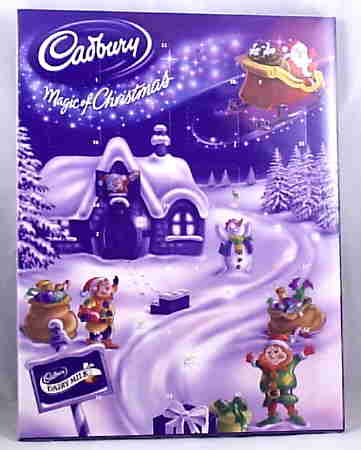
Jenn will be hosting the next Loveliness Fair ~ The Loveliness of Advent. The Fair will be ready for visitors on November 29 .
This week, we finalized some of our Advent preparations.
You may recall, that at the start of this "school" term, in October, we planned some ideas for the term. These plans included an internet search for more Advent ideas.
I pulled some of the ideas together during the week.
On Thursday, we made an Advent wreath, stealing the ideas from the blog O Night Divine.
Our other Advent wreath was made ten years ago - and the current four children homeschooling were nearly 1, 3, 5, and 7 then. So, it was a craft mostly compiled by the then older three homeschoolers ( now homeschool graduates).
I thought a new Advent wreath was overdue.
We adapted the idea from the blog above and spray painted our wreath, adding greenery and fake poinsettia and small pine cone shaped tea candles.
Here is a simple Advent Wreath paper craft to try.

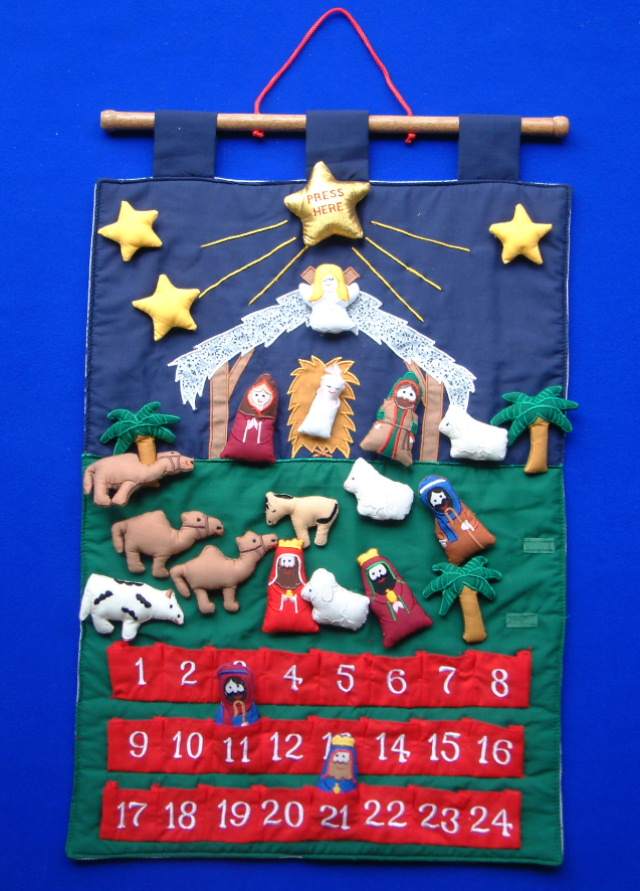
Our Advent preparations this week also included our Advent calendar. We have two.
Each year, we purchase a Cadbury Co. chocolate Advent calender - very commercial of us, I know, but it is something we've done since our oldest son was a preschooler. He is now in his 20s! We all look forward to the calendar and the chocolate. You can see the Cadbury calendar above.
Then, we also usually make some sort of Advent calendar. Or calendar of Advent ideas.
This year, we are using a cloth calendar that I bought on sale from a Christmas shop at the close of the last Christmas season . Similar to the one in the picture.
Thomas typed and printed a list of activities, which we cut and folded and placed in the appropriate pockets. I added a few sweets to the pockets, here and there.
This is Thomas' list ~
6th Feast of Saint Nicholas make Christmas cookies
13th Feast of Saint Lucy make Saint Lucy’s crown
4th feast of Saint Barbara check the weather
16th Begin Xmas Novena
Make and mail Christmas cards
Do something nice for another family member today
Sing Christmas carols
Sing Christmas carols
Sing Christmas carols
2,3,9,10 cat Christmas photos
Christmas photo
Put up Christmas tree
8th Immaculate conception
Walk or drive to see the Christmas lights
Visit Christmas In the city
Christmas Advent crafts
Christmas Advent crafts
Christmas Advent crafts
Christmas Advent crafts
Read Christmas books
Listen to Christmas music
Read Christmas story from the bible
Make Christmas cake
Do Christmas shopping
Make Christmas food
3rd first Sunday of advent
10th second Sunday in advent
17th third Sunday in advent
24th fourth Sunday in advent
Other years, we have made Advent coloured paper chains and simple home made Advent calendars.

So, what do we plan to do during Advent?
~ Everyone is choosing a spiritual/theological book to read during Advent. The kids typically choose a biography of a saint. I used to read aloud these books to the little ones.
~We will choose our "Advent penances."
~ Each week, we will click on one of the dates of that week on this online Advent activity calendar. We will follow the suggestions for reading, Bible readings, activities and even Christmas movies! It would be awesome to do this daily, but impractical given our schedules. A weekly Advent morning suits us fine.
~We will re-assemble our basket and box of Christmas and Advent books and movies. We have been judiciously collecting these over the years.
~I have already strewed an old Abeka literature text, one with a section of Christmas stories - including Dicken's "A Christmas Carol."
~We were thinking of making cards this year (didn't last year, either) - but got a good deal on religious cards at the piety stall at church. Who can resist?
~ We are planning our Christmas shopping lists - thinking ahead of how to share the joy via gifts and food.
~ We might try our hand at these Christmas tree ornaments from recycled Christmas cards. We might give the holiday biscotti recipe a whirl. It all depends on the time factor.
~ And we are making a gingerbread house - with a kit! Sorry, but this seems so much more positive and likely to succeed than making everything from scratch. Last year, we made mock gingerbread houses, with milk coffee biscuits - see these directions. The directions call for graham crackers. I have no idea what graham crackers are - as I said, we used Aussie/English milk coffee biscuits.
~ I have invited a few other Catholic homeschoolers over during Advent. We will pray the Rosary and Father will give us an Advent Blessing. We plan to follow this with morning tea/lunch.
~ During Advent, we will be finishing off our term activity - homemade books - Alexander is completing his mini book of three essays, Thomas is almost done with writing his cookbook and Anthony has a chapter to go on his world history of an imaginary land. Jonathon will start and complete a small book of some of his artwork or writing from this year.
~ Oh, and some of us will be attending the Advent programme at our parish - starts this Wednesday.
Here's wishing all a Happy and Busy Advent!
"It might be easy to run away to a monastery, away from the commercialization, the hectic hustle, the demanding family responsibilities of Christmas-time. Then we would have a holy Christmas. But we would forget the lesson of the Incarnation, of the enfleshing of God—the lesson that we who are followers of Jesus do not run from the secular; rather we try to transform it. It is our mission to make holy the secular aspects of Christmas just as the early Christians baptized the Christmas tree. And we do this by being holy people—kind, patient, generous, loving, laughing people—no matter how maddening is the Christmas rush…" Fr. Andrew Greeley
Thursday, April 17, 2008
We all need some semblance of planning to get us through
We all need some semblance of planning to get us through.
Even I as a kinda unschooler.
As Theresa notes, unschooling is not defined by what we don't do but by what we do. She quotes this article ~
2. Forget about what we are NOT doing. Far too often the focus of unschooling becomes what we are not doing. When we find ourselves starting to describe our philosophy in negative terms (we do not follow a curriculum, we do not do worksheets, we do not limit our learning to school hours, we do not force the memorization of facts and figures), we need to stop and consider the message we are communicating. Unschooling isn’t about creating a vast landscape of things not done. It’s about doing. We interact with our children and respect them as individuals. We follow their interests, and we follow our own. We explore and learn alongside them. We are open to new ideas and experiences in a multitude of shapes and forms. We act as facilitators when their interests lead them to subjects we cannot personally help them with. As unschoolers we do, rather than do not.
Someone said to me at dinner the other night, that he thought my kids were clever and intelligent but couldn't figure out how since we did so little schoolwork ( he knows our family well!). I think he was thinking of all we are not doing and not of all we DO.
I fall into the same trap. I get into survival mode. I wonder how we will fit eveything into our lives.
When I am feeling overwhelmed ( too much to do) I have found I need to sit down, perhaps when kids are asleep or watching a DVD, and put thoughts on paper. Getting it all on paper, in a notebook or journal - or blog , clears my head.
I pray.
I also write up rough schedules - yes I am an unschooler but I need to see that it *is* possible to fit everything into my week! Or where I can simplify. OCD or something.
Of course, we never follow these schedules but having them helps me feel better. I know it is possible to fit everything in.... I also make up meal lists and ideas lists for spending time with the kids and any formal work.
Can you see I am a list maker?
And I remind myself, when I feel that we are in survival mode, that I am getting the most important things done, that I am after progression not perfection, that there is time to do everything God wants me to do, don't rush it, take time to enjoy it. These little mantras keep me going when I have a tendency to feel like I am just treading water or always playing catch up.
I plan by the seat of my pants - typically I use my personal planner/diary and jot down activites/bookwork as I think they will fit into our weeks or as I hear about a good idea and think - well, Friday is free so we might try it then.
As for a log, I vary from year to year. Last year, I designed a form with curriculum areas and sample activities listed - I could circle what we did and add a note every few days.
This year I have returned to my old standard - in an attractive notebook, I write down what we do in brief note form and the curriculum area. Technically I do this daily but in real life, it is every few days.
So, Monday the formal work I had suggested was working on writing, maths sheets, French homework.
What we actually did looked like this in our log ~
ENGLISH Silent reading; more writing on novels
MATHS Numbers TV show - pursuit theory; Kumon
LANGUAGE French homework
ARTS Music practice
SOCIETY AND ENVIRONMENT Reading Horrible Histories magazines; reading Gibbon's Decline and Fall of the Roman Empire
TECHNOLOGY Computer; Design - model making; Food and tech - make pasta and home made bread for dinner ( one son's turn to cook)
PE/PD/HEALTH Trampoline; weight training; Work ed - work at Mum's Kumon centre.
So why am I writing all this down?
These are ideas we have been discussing, at the 4 Real Learning Forum and at the Unschooling Catholics email list.
These are also ideas that I am sorting through mentally ( mentally as in silently and on my blog! ).
Sorting through as I look at my family's lifestyle, my work commitments, the whole issue of time with the kids and with dh.
Even I as a kinda unschooler.
As Theresa notes, unschooling is not defined by what we don't do but by what we do. She quotes this article ~
2. Forget about what we are NOT doing. Far too often the focus of unschooling becomes what we are not doing. When we find ourselves starting to describe our philosophy in negative terms (we do not follow a curriculum, we do not do worksheets, we do not limit our learning to school hours, we do not force the memorization of facts and figures), we need to stop and consider the message we are communicating. Unschooling isn’t about creating a vast landscape of things not done. It’s about doing. We interact with our children and respect them as individuals. We follow their interests, and we follow our own. We explore and learn alongside them. We are open to new ideas and experiences in a multitude of shapes and forms. We act as facilitators when their interests lead them to subjects we cannot personally help them with. As unschoolers we do, rather than do not.
Someone said to me at dinner the other night, that he thought my kids were clever and intelligent but couldn't figure out how since we did so little schoolwork ( he knows our family well!). I think he was thinking of all we are not doing and not of all we DO.
I fall into the same trap. I get into survival mode. I wonder how we will fit eveything into our lives.
When I am feeling overwhelmed ( too much to do) I have found I need to sit down, perhaps when kids are asleep or watching a DVD, and put thoughts on paper. Getting it all on paper, in a notebook or journal - or blog , clears my head.
I pray.
I also write up rough schedules - yes I am an unschooler but I need to see that it *is* possible to fit everything into my week! Or where I can simplify. OCD or something.
Of course, we never follow these schedules but having them helps me feel better. I know it is possible to fit everything in.... I also make up meal lists and ideas lists for spending time with the kids and any formal work.
Can you see I am a list maker?
And I remind myself, when I feel that we are in survival mode, that I am getting the most important things done, that I am after progression not perfection, that there is time to do everything God wants me to do, don't rush it, take time to enjoy it. These little mantras keep me going when I have a tendency to feel like I am just treading water or always playing catch up.
I plan by the seat of my pants - typically I use my personal planner/diary and jot down activites/bookwork as I think they will fit into our weeks or as I hear about a good idea and think - well, Friday is free so we might try it then.
As for a log, I vary from year to year. Last year, I designed a form with curriculum areas and sample activities listed - I could circle what we did and add a note every few days.
This year I have returned to my old standard - in an attractive notebook, I write down what we do in brief note form and the curriculum area. Technically I do this daily but in real life, it is every few days.
So, Monday the formal work I had suggested was working on writing, maths sheets, French homework.
What we actually did looked like this in our log ~
ENGLISH Silent reading; more writing on novels
MATHS Numbers TV show - pursuit theory; Kumon
LANGUAGE French homework
ARTS Music practice
SOCIETY AND ENVIRONMENT Reading Horrible Histories magazines; reading Gibbon's Decline and Fall of the Roman Empire
TECHNOLOGY Computer; Design - model making; Food and tech - make pasta and home made bread for dinner ( one son's turn to cook)
PE/PD/HEALTH Trampoline; weight training; Work ed - work at Mum's Kumon centre.
So why am I writing all this down?
These are ideas we have been discussing, at the 4 Real Learning Forum and at the Unschooling Catholics email list.
These are also ideas that I am sorting through mentally ( mentally as in silently and on my blog! ).
Sorting through as I look at my family's lifestyle, my work commitments, the whole issue of time with the kids and with dh.
Sunday, February 26, 2012
Strewing their paths...late February
To strew. To lay interesting thing in the paths of our children, our families, our unschooling sons and daughters. Well, sons in my case. Or son. The lone unschooler.
Sandra Dodd coined this term "strewing" within an unschooling context.
And it works. It sparks an interest, it allows for exposure, it provides another knot to that mental hammock of information.
Even when a parent is in absentia. As I have been in February, due to work commitments.
You know Arnie Schwarznegger in the movie Jingle All the Way, that almost always absent dad? That's been me. But at least everyone knows its only temporary (roll on March!).
And I have been strewing. So sparks are sown without me.
Making a salt dough crown of thorns with some sons. And me varnishing it late at night and decorating the table for Lent so that is the first thing everyone sees as they come downstairs in the morning. When I am already at work.
Asking Anthony to find an icon of Sts Cyril and Methodius while I hang streamers for St Valentine. While a very late, very easy dinner is cooking.
Taking a Saturday afternoon to clean the garage and find interesting new-to-some books to share....Dorothy Sayers' Creed or Chaos?, Kim Philby's account of the Philby spy scandal that rocked Britain and that on which the film and book Tinker Tailor Soldier Spy is based, Joyce Vedrals' book The 12 Minute Workout for those sons bemoaning their lack of workout time once Uni starts, Party Shoes by Noel Streatfield ( for me! But lead to discussion and a maybe we should watch Ballet Shoes again?), an Italian Reader for Thomas who is saving to go to Rome for a Latin school in July....
Other strewing? Reading about St Wahlburga after mass and Anthony looking up Saxon inspired desserts for Sunday.
A trip to Kikki K....just walking in the door makes one feel more organized already!
Setting up games days and times to hang with friends and lifts to and from drama and New Testament Greek class and buses to youth group for Anthony, the lone but not alone unschooler.
Making lists.....can someone make pancakes for Shrove Tuesday (Shrove Monday in this house this year!), can someone find a Gregorian chant CD, can someone vacuum or hang out laundry or post this letter and the myriad of other chores that make up Life Skills and Personal Development.
On the rare but treasured hang out with family nights...watching some of the Numbers series and discussing religion and faith and Maths and family and crime, watching Music and Lyrics and loving the dialogue, a mini Harry Potter marathon... Deathly Hallows Part One and Two and reminiscing about the books and characters and choices.
And my kids helping me with so much Kumon work and my thank you to my kids and to my other assistants...our nearly end of Kumon dinner at a local Chinese restaurant.
This is what unschooling looks like.
This is what unschooling strewing looks like.
It looks a lot like life, doesn't it?
But life strewed with and lived with purpose and intent.
An observer may see no visible signs of learning (You wrote down a sneeze as Health! That tongue in cheek comment!). And yet the observer can know that there is learning and intent. Time is structured, by interest and by strewing, not necessarily by school. And education happens. With the spark or interest in learning retained.
That's unschooling. That's unschooling strewing.
Sandra Dodd coined this term "strewing" within an unschooling context.
And it works. It sparks an interest, it allows for exposure, it provides another knot to that mental hammock of information.
Even when a parent is in absentia. As I have been in February, due to work commitments.
You know Arnie Schwarznegger in the movie Jingle All the Way, that almost always absent dad? That's been me. But at least everyone knows its only temporary (roll on March!).
And I have been strewing. So sparks are sown without me.
Making a salt dough crown of thorns with some sons. And me varnishing it late at night and decorating the table for Lent so that is the first thing everyone sees as they come downstairs in the morning. When I am already at work.
Asking Anthony to find an icon of Sts Cyril and Methodius while I hang streamers for St Valentine. While a very late, very easy dinner is cooking.
Taking a Saturday afternoon to clean the garage and find interesting new-to-some books to share....Dorothy Sayers' Creed or Chaos?, Kim Philby's account of the Philby spy scandal that rocked Britain and that on which the film and book Tinker Tailor Soldier Spy is based, Joyce Vedrals' book The 12 Minute Workout for those sons bemoaning their lack of workout time once Uni starts, Party Shoes by Noel Streatfield ( for me! But lead to discussion and a maybe we should watch Ballet Shoes again?), an Italian Reader for Thomas who is saving to go to Rome for a Latin school in July....
Other strewing? Reading about St Wahlburga after mass and Anthony looking up Saxon inspired desserts for Sunday.
A trip to Kikki K....just walking in the door makes one feel more organized already!
Setting up games days and times to hang with friends and lifts to and from drama and New Testament Greek class and buses to youth group for Anthony, the lone but not alone unschooler.
Making lists.....can someone make pancakes for Shrove Tuesday (Shrove Monday in this house this year!), can someone find a Gregorian chant CD, can someone vacuum or hang out laundry or post this letter and the myriad of other chores that make up Life Skills and Personal Development.
On the rare but treasured hang out with family nights...watching some of the Numbers series and discussing religion and faith and Maths and family and crime, watching Music and Lyrics and loving the dialogue, a mini Harry Potter marathon... Deathly Hallows Part One and Two and reminiscing about the books and characters and choices.
And my kids helping me with so much Kumon work and my thank you to my kids and to my other assistants...our nearly end of Kumon dinner at a local Chinese restaurant.
This is what unschooling looks like.
This is what unschooling strewing looks like.
It looks a lot like life, doesn't it?
But life strewed with and lived with purpose and intent.
An observer may see no visible signs of learning (You wrote down a sneeze as Health! That tongue in cheek comment!). And yet the observer can know that there is learning and intent. Time is structured, by interest and by strewing, not necessarily by school. And education happens. With the spark or interest in learning retained.
That's unschooling. That's unschooling strewing.
Tuesday, May 27, 2008
So, what do unschooling teens do?

Unschooling teens = autodidacts.
Self taught.
As in Kendall Hailey's book The Day I Became An Autodidact.
[A great read, by the way..I own it if you want to borrow it.... ]
So, back to the original question. What do teen autodidacts do with their days?
This question came to my mind recently, when reading mail from the Unschooling Catholics email list.
I thought I'd post about today, a day for two of my teen sons. Thomas 15. Alexander 16 1/2. Or maybe - nearly 15 1/2, nearly 17. Who can keep track ?
How does a day of Living Without School translate for these two teens?
Alexander got up, he is an early riser. He did a yoga and martial arts workout, chatted to me and helped me with a few chores. Then he made his breakfast ( toast), tidied his room, and we had French class at our home.
I had some appointments for WYD Homestay so went out early, and came back halfway through French to take Alexander with me to yet another WYD appointment – he is learning to drive and wants the practice.
While at the lady’s home, A helped set up her DVD player and ate scones.
Home again, A stayed home to fold pamphlets for delivery with the 12 year old - Anny, while the rest of us went out, to drop the 15 year old - Thomas - to one of his part time jobs, for me to get my nails done ( very important) , one son - Greg - to pick up something he ordered from the shops.
Alexander folded pamphlets for delivery with Anthony, then played guitar and read email while we were out.... We’ve had lunch and talked about when A is going to fit in his uni assignment that is due Friday – he is doing one subject part time externally through university, Open University, - Italian. And about the extra help I need, as I am (supposed to be) resting with some superficial blood clots..
This afternoon, A will go to one of his part time jobs, at a nearby Kumon centre ( not mine!) till 6-ish and then we have the St Anthony Mass in our parish tonight, dinner after, probably watch some TV or a DVD and do some reading.
The other teen's day?
Self taught.
As in Kendall Hailey's book The Day I Became An Autodidact.
[A great read, by the way..I own it if you want to borrow it.... ]
So, back to the original question. What do teen autodidacts do with their days?
This question came to my mind recently, when reading mail from the Unschooling Catholics email list.
I thought I'd post about today, a day for two of my teen sons. Thomas 15. Alexander 16 1/2. Or maybe - nearly 15 1/2, nearly 17. Who can keep track ?
How does a day of Living Without School translate for these two teens?
Alexander got up, he is an early riser. He did a yoga and martial arts workout, chatted to me and helped me with a few chores. Then he made his breakfast ( toast), tidied his room, and we had French class at our home.
I had some appointments for WYD Homestay so went out early, and came back halfway through French to take Alexander with me to yet another WYD appointment – he is learning to drive and wants the practice.
While at the lady’s home, A helped set up her DVD player and ate scones.
Home again, A stayed home to fold pamphlets for delivery with the 12 year old - Anny, while the rest of us went out, to drop the 15 year old - Thomas - to one of his part time jobs, for me to get my nails done ( very important) , one son - Greg - to pick up something he ordered from the shops.
Alexander folded pamphlets for delivery with Anthony, then played guitar and read email while we were out.... We’ve had lunch and talked about when A is going to fit in his uni assignment that is due Friday – he is doing one subject part time externally through university, Open University, - Italian. And about the extra help I need, as I am (supposed to be) resting with some superficial blood clots..
This afternoon, A will go to one of his part time jobs, at a nearby Kumon centre ( not mine!) till 6-ish and then we have the St Anthony Mass in our parish tonight, dinner after, probably watch some TV or a DVD and do some reading.
The other teen's day?
Thomas (15) woke up - I yelled 'Are you up Thomas, French is here this morning...' and opened my door - T was standing outside the door with a smile. I was caught out!
Thomas did Wii Fitness, our family's new favourite fitness toy ( not that I am allowed back to workouts ), tidied his room ( sort of), played computer, eventually ate breakfast ( goodness knows what), attended French class at our house, did some Maths while I was out and then we dropped him off at one of his part time jobs – McDonalds. He will finish at 5 – in time for a shower, Mass, dinner, etc.
So, their days are not very school-ish and mostly managed by themselves – we just talk the night before or in the morning and every few months or so, about what is happening ( we are all involved in many things) and about any thing that needs doing, interests and passions and goals and have-tos, problems, issues concerns….
An education for autodidacts. Or Self Directed Learning, to quote this article by Cafi Cohen on older kids and homeschooling.
Thomas did Wii Fitness, our family's new favourite fitness toy ( not that I am allowed back to workouts ), tidied his room ( sort of), played computer, eventually ate breakfast ( goodness knows what), attended French class at our house, did some Maths while I was out and then we dropped him off at one of his part time jobs – McDonalds. He will finish at 5 – in time for a shower, Mass, dinner, etc.
So, their days are not very school-ish and mostly managed by themselves – we just talk the night before or in the morning and every few months or so, about what is happening ( we are all involved in many things) and about any thing that needs doing, interests and passions and goals and have-tos, problems, issues concerns….
An education for autodidacts. Or Self Directed Learning, to quote this article by Cafi Cohen on older kids and homeschooling.
Monday, August 15, 2005
Chicken pox, birthdays and outings
We meant to post more regularly - then three boys came down with chicken pox. It's a miserable sickness, makes you feel itchy and ugly and isolated...
As recovery approached, so did the youngest boy's birthday - ten years old! He has been trying to convince us that being ten makes him a teenager - you know, two digits!
And we have had a week of outings or visits and a myriad of follow-up discussions.
Our oldest three sons were visiting from interstate and the eldest brought a friend for the weekend.
We went to the science museum and got immersed in Greek treasures, Byzantine art, looking at Angus Young's guitar ( from ACDC) and life inside a space shuttle.
We played games of Star Wars Trivia and Hero Scape ( both birthday presents). And Avalanche on the Game Cube - talked angles and degrees here.
Walked around our neighbourhood and the nature reserve and lake and talked about the drought and the wattle.
Visited the Aquarium - I love the peacefulness of the underwater displays. I could stay down there forever. The boys enjoyed the sharks and the touch pool, and the gift shop.
Had our usual skateboarding group lesons with other homeschoolers. The teacher loves skateboarding and is good at it but seems to have no understanding of those who find it hard. One son and I had a long discussion about this, after an altercation and criticism from the instructor.
What makes a good teacher? Is it just being good at something? Or do you need something more - an empathy or understanding in addition to a passion? I must re-read some of John Holt as I remember that he had a number of comments to make about teaching and learning.
We started a teen group - the first meeting was at our house this week. Fifteen homeschooled teens, with their mothers and younger siblings turned up! What was interesting was the discrepancy of ideas for the group, amongst both teens and parents. Some want more activity oriented groups. Some want to hang out.
We are going to try a mix of both and see where it leads - friendships, things to do, interests.
And we finished off the week with Group learning - a co-op activity. I was the facilitator for the electricity stations. It's very school-ish but has been a way for us to meet others in our new area. I must admit that the kids liked the lemon battery experiment and also enjoyed making a pizza box solar oven.
The two teens went to youth group and also iceskating with some friends from drama class.
And the rest of us went skateboard shopping. Oh, and the ten year old bought a Tamagotchie ( a virtual pet). So, today we are discussing friends for the pet, and marriage for the future!
I gues that this is what I love about homeschooling - we don't fit school around life or life around school. Life is learning.
As recovery approached, so did the youngest boy's birthday - ten years old! He has been trying to convince us that being ten makes him a teenager - you know, two digits!
And we have had a week of outings or visits and a myriad of follow-up discussions.
Our oldest three sons were visiting from interstate and the eldest brought a friend for the weekend.
We went to the science museum and got immersed in Greek treasures, Byzantine art, looking at Angus Young's guitar ( from ACDC) and life inside a space shuttle.
We played games of Star Wars Trivia and Hero Scape ( both birthday presents). And Avalanche on the Game Cube - talked angles and degrees here.
Walked around our neighbourhood and the nature reserve and lake and talked about the drought and the wattle.
Visited the Aquarium - I love the peacefulness of the underwater displays. I could stay down there forever. The boys enjoyed the sharks and the touch pool, and the gift shop.
Had our usual skateboarding group lesons with other homeschoolers. The teacher loves skateboarding and is good at it but seems to have no understanding of those who find it hard. One son and I had a long discussion about this, after an altercation and criticism from the instructor.
What makes a good teacher? Is it just being good at something? Or do you need something more - an empathy or understanding in addition to a passion? I must re-read some of John Holt as I remember that he had a number of comments to make about teaching and learning.
We started a teen group - the first meeting was at our house this week. Fifteen homeschooled teens, with their mothers and younger siblings turned up! What was interesting was the discrepancy of ideas for the group, amongst both teens and parents. Some want more activity oriented groups. Some want to hang out.
We are going to try a mix of both and see where it leads - friendships, things to do, interests.
And we finished off the week with Group learning - a co-op activity. I was the facilitator for the electricity stations. It's very school-ish but has been a way for us to meet others in our new area. I must admit that the kids liked the lemon battery experiment and also enjoyed making a pizza box solar oven.
The two teens went to youth group and also iceskating with some friends from drama class.
And the rest of us went skateboard shopping. Oh, and the ten year old bought a Tamagotchie ( a virtual pet). So, today we are discussing friends for the pet, and marriage for the future!
I gues that this is what I love about homeschooling - we don't fit school around life or life around school. Life is learning.
Sunday, July 11, 2010
Are they all at home reading Tolstoy before these parties?
So asks David Gilmour, in his book The Film Club, a book I have discussed here.

Writing about his son and his son's ex-girlfriend...They had spoken for only moments when she whispered "If you keep looking at me like that, I'm going to have to kiss you" (My God, where do they learn this stuff? Are they all at home reading Tolstoy before these parties?)
Are they? Do language, thoughts, vocabulary come from life and books and movies, and from experiences? In our case, from our family's unschooling lifestyle ( no school! lots of books and talking!) and our life as Catholics in the Church.
A typcal unschooling day here involves prayer and the liturgical year and resources and experiences and discussion. It makes no difference whether it is a weekend or a weekday, in terms of educational outcomes and learning.
Non scholae, sed vitae discimus..We do not learn for the school, but for life...the Roman philosopher Seneca
Yesterday, waiting for a friend at Darling Harbour, I read a blog post about liturgy. I followed the link, to read more of "liturgical disobedience".
In the encyclical "Ecclesia de Eucharistia," Pope John Paul II manifested his displeasure over the liturgical abuses that have often taken place, particularly in the celebration of Holy Mass, in as much as "the Eucharist is too great a gift to endure ambiguities and diminutions."And he added: "Unfortunately, it is to be lamented that, above all beginning with the years of the post-conciliar liturgical reform, because of a misunderstood sense of creativity and adaptation, there has been no lack of abuses, which for many have been the cause of uneasiness. A certain reaction to 'formalism' has led some, especially in certain regions, to consider the 'forms' adopted by the great liturgical tradition of the Church and her magisterium as not obligatory and to introduce unauthorized innovations often all together unsuitable. "Hence, I feel it my duty to make an urgent call to attention so that liturgical norms are observed with great fidelity in the Eucharistic celebration. They are concrete expressions of the authentic ecclesiality of the Eucharist; this is its most profound meaning. The liturgy is never someone's private property, either of the celebrant or of the community in which the mysteries are celebrated.OBSERVANCE OF LITURGICAL NORMS AND "ARS CELEBRANDI"
Having (sadly) experienced our fair share of the results of liturgical disobedience, it was natural for me to discuss the linked article with some of my sons, when we met up again , for a quick meal, before a Holy Hour of adoration.
We talked about how a seemingly novel and new and pleasing-to-some innovation to the liturgy, a Praise the Lord greeting at the beginning and close of Mass, at the beginning and close of the homily, with a resounding PTL expected to be said by the congregation, how this phrase soons becomes old. Banal. Meaningless. The greeting is now uttered out of force of habit; the response is called out mindlessly and without thought, as we might say "Hi, how are you" in passing, not a real enquiry but a social response. Not a real praising and adoration of Our Lord but a phrase we mutter because it is expected.
And so, as my sons as I discussed, we ending up talking about how adding to sacred liturgy, to the sacred language of the Mass, becomes nothingness, that grey, dull nothingness that creeps over the land in the book and movie The Never Ending Story, how we lose sight of God and of real worship when step away from the rituals and language set by the Church for the good of souls...and how someone must cry out against this, as Bastien cries out his mother's name in The Never Ending story, to name the Princess and stop the nothingness.
We may not read Tolstoy today but all our experiences, of faith and liturgy, of books and movies, come together in our discussions. Students understand that language has an important effect on the ways in which they view themselves and the world in which they live...
Students understand that peoples’ actions and values are shaped by their understanding
and interpretation of the past. (The Curriculum Framework).
Students understand that peoples’ actions and values are shaped by their understanding
and interpretation of the past. (The Curriculum Framework).
A typical unschooling day involes this kind of learning, meeting educational outcomes via language and thought. A typical unschooling day takes our shared history of books and movies, of learning activities, of formal work, of classes this week in Old Norse at Macquarie University, and weaves it into an educational life. A typical unschooling day involves prayer and often mass, the public worship of the Church. And celebrating the liturgical year..Ordinary Time, Lent, Advent, Ember Days, the calendar of Saints.
And my reading can become fodder for discussion and for the reading of my sons.
Even our experiences of liturgical disobedience can become part of our educational process, as we explore and discuss exactly what it is that the Church teaches and why. And then we stand for what is right.
Or, in our case, we kneel. Kneel for Communuon, to receive Our Lord.
Last week, we heard in Mass, that the hand with which we reach out to others is the hand with which we receive the Eucharist. What an honour it is , the priest said, to receive Jesus in our hands.
We took this fallacious argument away and inadvertantly began a discussion on logic and fallacies. Another learning outcome approached...Students investigate to answer questions and with reflection and analysis prepare a plan; to collect, process and interpret data; tocommunicate conclusions; and to evaluate their plan, procedures and findings.
Yesterday, we read..
The mystery of the Eucharist is too great 'for someone to allow himself to treat it with his own personal choice, which would not respect either its sacred character or its universal dimension.' Arbitrary acts do not benefit true renewal, but harm the true right of the faithful to liturgical action, which is expression of the life of the Church, according to her tradition and discipline...Derived from these arbitrary acts are uncertainty in doctrine, doubt and scandal for the People of God and, almost inevitably, a violent repugnance that confuses and afflicts forcefully many faithful in our times, in which frequently Christian life suffers the very difficult environment of 'secularization.' (From the article cited above)
Cardinal Newman wrote of the need for an educated laity; he also warned that we not have an arrogant educated laity but an educated laity that is pious and thus humble. In our discussions, on books and movies, on our formal text work, on the Faith, we need also to question ourselves. To remember that awe, that fear of the Lord.
It is here again that the Church draws us close. As we celebrate the liturgical year, as we unschoolers today turn the page of the calendar of saints, to July 11, to St Benedict, I share St Benedict's Eight Steps to Humilty and we read that The first step of humility, then, is that a man keeps the fear of God always before his eyes (Ps 35 [36]:2) and never forgets it.
Our discussion has ranged from what is fear of the Lord , to the definition of a Father, to awe in liturgy, to that which is sacred..and how, we can be guilty of the sin of pride but the Sacraments, a reverent liturgy, celebrated according to the rubrics of the Church, bring us to our knees in adoration. Bring us to that fear of Lord, for without Him and His Love we are abandoned , we are secularized.
It is expressed thus, for example, by the Holy Father Benedict XVI: "The first way with which the participation of the People of God in the sacred rite is fostered is the proper celebration of the rite itself. The 'ars celebrandi' is the best premise for the 'actuosa participatio.' The 'ars celebrandi' stems from faithful obedience to the liturgical norms in their plenitude, as it is precisely this way of celebrating which has ensured for two thousand years the life of faith of all believers, who are called to live the celebration as People of God, royal priesthood, holy nation. (Ibid)
Saturday, May 27, 2006
Literature, Themes and Homeschooling.
Recently, I joined a group of fellow homeschooling mothers at an evening meeting. We had gathered together to discuss our plans for home education for the next term.
A number of us described our homeschooling as relaxed, natural learning, Charlotte mason inspired – with themes. A definite eclectic blend of homeschooling styles.
Our discussion of themes lead several mothers to ask - “How does one take a non textbook, interest driven, theme approach?”
Well, in our homeschool, our themes and current interests and passions often revolve and evolve on literature.
“In literature, perhaps than through any other art from, we are able to get into the other man’s shoes.” Susan Schaefer Macauley, in “For the Children’s Sake.”
I find that relationships form the basis of our home education. These relationships, relationships with ideas and with life and with knowledge and with each other, are formed as we share books together.
We use books and real life activities in our home school and couple these with a follow-up on interest areas and, thus, almost inadvertently, include curricula areas. These basic curricula areas are often studied in the light of a whole, interesting, living book. Children can see how all learning and all areas inter-relate and can grasp the wholeness of knowledge and skills. Those skills considered basic can be learned in the study of an interest or a passion – a theme related to a good book.
“Integrating classics and historical novels into your unit studies is an effective teaching method; however, reverse this technique, allowing the classics or novels to be the main emphasis of your study.” Valerie Bendt, in “How to Create Your Own Unit Study”
I can skim a booklist, or skim books on shelves at home or at the library or at a bookstore. Often, I find a book that relates to a current interest. Or one that relates to a topic or a time period or a place or a curricula area.
Last year, weread aloud from “Hatchet” by Gary Paulsen and from “Tomorrow When the War Began” by John Marsden. These books easily lead into questions on science, nature, survival, personal issues.
Earlier this year, we read together from the picture book “Michelangelo” by Diane Stanley. This book gave us an historical focus.
I can simply choose a good book, a good read. A book my children and I will enjoy and thus benefit from. We can read this book and explore “rabbit trails” (curricula areas) as they flow from our reading and discussion and outings and movies.
If one takes a “post programming” approach to homeschool documentation, it is easy to check the outcomes for your children’s levels, with regard to your state’s curriculum documents. Check these after your theme reading and activities, at the natural closure of your theme. These guides are usually available from the relevant state education website. Alternatively, you can look at a scope and sequence guide online or in a book on home education and tick those areas/skills covered via your book and life explorations.
What if you want a pre-planned theme?
With book in hand, you may skim through the pages, noting down any key people, events, places, inventions, discoveries, trades – you name it. My high school age children enjoy this project and it often becomes a race to see which connections are made.
On your next library trip ( in real life or using the online catalogue), you and your children can peruse the resources for suitable biographies, non fiction books, picture books ( an excellent picture book is good for all ages), art or music or craft books., CDs, poetry, cooking books, DVDs, science experiment books….
Look for online resources with a Google search. Scan Australian educational and homeschool suppliers for book ideas.
You can do one or all of the things above.
Then, try to select one or two key books as your “basic texts”, to round out your shared literature. Perhaps you may find fiction or non-fiction in the same series or by the same author or on the theme topic.
On paper, list the eight curricula areas . Jot down any ideas for each area - you will have ideas, your children will have ideas, the books from the library or the websites you have collected will have ideas. .
Keep this brief as it is good to be open to what I call serendipity – the leading of our children and of our daily life and our reading and discussion, for follow-up activities.
Don’t exhaust yourself in trying to cover everything on a theme. There is always another term and another theme. Check the scope and sequence or outcome statements for your children’s “levels”, note the areas you are covering, and glean ideas for possible future literary themes.
It is hard not to cover the usual subject areas when reading good books together and sharing our day to day lives. As we read literature, enjoy excellent movies and picture books, visit parks and museums, cook and talk and play, we find many interesting and varied details. These provide both children and adults with an array of interesting material to explore and learn.
How does this work in our homeschool?
During the winter last year, we read “Hatchet”. We looked for books on rivers/ponds/oceans and on rocks and minerals (geology).
We found many interesting DVDs – some movies (Journey to the Centre of the Earth, 20,000 Leagues Under the Sea. The Core, Volcano!, Whale Rider). Some documentaries – The Deep, Discovery Channel Sharks, for example.
We found several good fiction and non fiction books on our themes – the Heinemann Australian Investigate series from the library, books by Isaac Asimov, Kon Tiki, The Black Pearl…..
An internet search revealed websites with complete themes for primary grades and activities and experiments for older children.
Already, a theme had developed. We could cover many usual curricula areas via our reading, writing, drawing, and doing.
We learned about Karst topography and made a sugar cube model. We made an earth bowl pie. We planned a dinner using foods from the seas and from rivers/ponds. We decorated menus for the dinner. We made paper fish models and labeled oceans in English, French and German. We visited the Sydney Aquarium and the museum.
In educational terms, the children practiced many of the Basic English and Mathematical skills and outcomes; additionally, we covered outcomes in Human Society and Environment, in Science, in Technology, in Languages, in Arts.
And we all had a great deal of fun. I, and my sons, learned a lot during this literature based theme.
What are the advantages of creating your own literature based themes?
For us, it has been not only economical to use themes rather than textbooks, but also educational. The children become interested and see learning as connected. We all learn together, as a family. The workload is minimal for me as learning and reading and doing together becomes a way of life – just as it was when the children were toddlers. Pre or post programming, with the aid of a scope and sequence or outcome statements or typical course of study, takes a relatively short space of time at the start or end of each theme (or term). Journaling our daily or weekly or monthly activities becomes a family memory time.
And, in the words of Valerie Bendt – “For several years now, my family has been using the unit study [theme] approach to learning. My children’s attitudes about schoolwork have changed. They are interested in our studies and eager to learn. We occasionally have problems but not nearly so often as when we used textbooks and workbooks…My attitude has changed because I, too, am eager to learn. I see my attitude reflected in their eyes. We must set a good example for our children to follow. They know that much of the material we are learning is new to me also. We’re learning together…They aren’t bound by graded textbooks or by learning labels. They are free to learn at a rate that is appropriate for them…” ( from “How to Create your own Unit Study”)
A number of us described our homeschooling as relaxed, natural learning, Charlotte mason inspired – with themes. A definite eclectic blend of homeschooling styles.
Our discussion of themes lead several mothers to ask - “How does one take a non textbook, interest driven, theme approach?”
Well, in our homeschool, our themes and current interests and passions often revolve and evolve on literature.
“In literature, perhaps than through any other art from, we are able to get into the other man’s shoes.” Susan Schaefer Macauley, in “For the Children’s Sake.”
I find that relationships form the basis of our home education. These relationships, relationships with ideas and with life and with knowledge and with each other, are formed as we share books together.
We use books and real life activities in our home school and couple these with a follow-up on interest areas and, thus, almost inadvertently, include curricula areas. These basic curricula areas are often studied in the light of a whole, interesting, living book. Children can see how all learning and all areas inter-relate and can grasp the wholeness of knowledge and skills. Those skills considered basic can be learned in the study of an interest or a passion – a theme related to a good book.
“Integrating classics and historical novels into your unit studies is an effective teaching method; however, reverse this technique, allowing the classics or novels to be the main emphasis of your study.” Valerie Bendt, in “How to Create Your Own Unit Study”
I can skim a booklist, or skim books on shelves at home or at the library or at a bookstore. Often, I find a book that relates to a current interest. Or one that relates to a topic or a time period or a place or a curricula area.
Last year, weread aloud from “Hatchet” by Gary Paulsen and from “Tomorrow When the War Began” by John Marsden. These books easily lead into questions on science, nature, survival, personal issues.
Earlier this year, we read together from the picture book “Michelangelo” by Diane Stanley. This book gave us an historical focus.
I can simply choose a good book, a good read. A book my children and I will enjoy and thus benefit from. We can read this book and explore “rabbit trails” (curricula areas) as they flow from our reading and discussion and outings and movies.
If one takes a “post programming” approach to homeschool documentation, it is easy to check the outcomes for your children’s levels, with regard to your state’s curriculum documents. Check these after your theme reading and activities, at the natural closure of your theme. These guides are usually available from the relevant state education website. Alternatively, you can look at a scope and sequence guide online or in a book on home education and tick those areas/skills covered via your book and life explorations.
What if you want a pre-planned theme?
With book in hand, you may skim through the pages, noting down any key people, events, places, inventions, discoveries, trades – you name it. My high school age children enjoy this project and it often becomes a race to see which connections are made.
On your next library trip ( in real life or using the online catalogue), you and your children can peruse the resources for suitable biographies, non fiction books, picture books ( an excellent picture book is good for all ages), art or music or craft books., CDs, poetry, cooking books, DVDs, science experiment books….
Look for online resources with a Google search. Scan Australian educational and homeschool suppliers for book ideas.
You can do one or all of the things above.
Then, try to select one or two key books as your “basic texts”, to round out your shared literature. Perhaps you may find fiction or non-fiction in the same series or by the same author or on the theme topic.
On paper, list the eight curricula areas . Jot down any ideas for each area - you will have ideas, your children will have ideas, the books from the library or the websites you have collected will have ideas. .
Keep this brief as it is good to be open to what I call serendipity – the leading of our children and of our daily life and our reading and discussion, for follow-up activities.
Don’t exhaust yourself in trying to cover everything on a theme. There is always another term and another theme. Check the scope and sequence or outcome statements for your children’s “levels”, note the areas you are covering, and glean ideas for possible future literary themes.
It is hard not to cover the usual subject areas when reading good books together and sharing our day to day lives. As we read literature, enjoy excellent movies and picture books, visit parks and museums, cook and talk and play, we find many interesting and varied details. These provide both children and adults with an array of interesting material to explore and learn.
How does this work in our homeschool?
During the winter last year, we read “Hatchet”. We looked for books on rivers/ponds/oceans and on rocks and minerals (geology).
We found many interesting DVDs – some movies (Journey to the Centre of the Earth, 20,000 Leagues Under the Sea. The Core, Volcano!, Whale Rider). Some documentaries – The Deep, Discovery Channel Sharks, for example.
We found several good fiction and non fiction books on our themes – the Heinemann Australian Investigate series from the library, books by Isaac Asimov, Kon Tiki, The Black Pearl…..
An internet search revealed websites with complete themes for primary grades and activities and experiments for older children.
Already, a theme had developed. We could cover many usual curricula areas via our reading, writing, drawing, and doing.
We learned about Karst topography and made a sugar cube model. We made an earth bowl pie. We planned a dinner using foods from the seas and from rivers/ponds. We decorated menus for the dinner. We made paper fish models and labeled oceans in English, French and German. We visited the Sydney Aquarium and the museum.
In educational terms, the children practiced many of the Basic English and Mathematical skills and outcomes; additionally, we covered outcomes in Human Society and Environment, in Science, in Technology, in Languages, in Arts.
And we all had a great deal of fun. I, and my sons, learned a lot during this literature based theme.
What are the advantages of creating your own literature based themes?
For us, it has been not only economical to use themes rather than textbooks, but also educational. The children become interested and see learning as connected. We all learn together, as a family. The workload is minimal for me as learning and reading and doing together becomes a way of life – just as it was when the children were toddlers. Pre or post programming, with the aid of a scope and sequence or outcome statements or typical course of study, takes a relatively short space of time at the start or end of each theme (or term). Journaling our daily or weekly or monthly activities becomes a family memory time.
And, in the words of Valerie Bendt – “For several years now, my family has been using the unit study [theme] approach to learning. My children’s attitudes about schoolwork have changed. They are interested in our studies and eager to learn. We occasionally have problems but not nearly so often as when we used textbooks and workbooks…My attitude has changed because I, too, am eager to learn. I see my attitude reflected in their eyes. We must set a good example for our children to follow. They know that much of the material we are learning is new to me also. We’re learning together…They aren’t bound by graded textbooks or by learning labels. They are free to learn at a rate that is appropriate for them…” ( from “How to Create your own Unit Study”)
Thursday, July 19, 2007
A Homeschool Morning


Was this morning a typical homeschool morning? Probably not. But it has been a pleasant morning, an enjoyable morning, with learning being our lifestyle ... so, I thought I'd share....
Gerry was off to work early and Alexander and I woke early-ish, to workout. I tidied, did laundry, checked email, asked kids to help me clean uo the kitchen ~ the usual.
Jonathon has spent time studying for his uni exam tomorrow ( Screen History and Research) and discussing the effect of TV and cable TV on cinema attendance. Thomas checked ninemsn for news and we got into a discussion on the Liberal government, on Prime Minister John Howard and Treasurer Peter Costello.
Gerry was off to work early and Alexander and I woke early-ish, to workout. I tidied, did laundry, checked email, asked kids to help me clean uo the kitchen ~ the usual.
Jonathon has spent time studying for his uni exam tomorrow ( Screen History and Research) and discussing the effect of TV and cable TV on cinema attendance. Thomas checked ninemsn for news and we got into a discussion on the Liberal government, on Prime Minister John Howard and Treasurer Peter Costello.
Thomas and Anthony made a motorized model car - well, it is almost finished. Alexander tried reading more of "Harry Potter and the Philosopher's Stone" in Latin, with a Latin dictionary nearby!
Anthony worked on folders for his role playing game - writing, diagrams, statistics; and he and Thomas played a computer game, discussing strategies. Everyone played music - guitar and piano, singing along, listening to CDs.
Anthony went on a bike ride around our small housing estate ~ by himself!
The kids played basketball and "guns" , involving running around our end of the cul de sac and trying to shoot each other with foam bullets and toy guns. :-)
And there has been a lot of reading ~ the spoiler of the new
Harry Potter book, an anthology of 1960s humour ( including Thurber and Belloc), an autobiography of a fighter ace of WW2, Choose Your Own Adventure Dr Who. Anthony found my copy of "The Nun's Story". I have been looking for that book for ages, wanting to re-read it after I re-read Godden's "In This House of Brede" earlier this year.
Thomas cooked dinner for tonight, ahead of time! ~ I helped.Spaghetti and Meatballs. Alexander made signs for my Kumon centre and I worked on Kumon paperwork and phone calls and emails and on the parish newsletter.
I read aloud a bit about the saint for today - Blessed Peter ToRot , from Papua New Guinea.
Now, time for more laundry and lunch . Alexander ( and others) are going to watch an old Dr Who TV episode over lunch, with book comparisons, of course, and then we are off to work at Kumon. Anthony will do some Kumon English reading and writing work, until Gerry picks him up at 5 or 6-ish, while the rest of us are working at the centre.
A pleasant winter school morning!
Anthony worked on folders for his role playing game - writing, diagrams, statistics; and he and Thomas played a computer game, discussing strategies. Everyone played music - guitar and piano, singing along, listening to CDs.
Anthony went on a bike ride around our small housing estate ~ by himself!
The kids played basketball and "guns" , involving running around our end of the cul de sac and trying to shoot each other with foam bullets and toy guns. :-)
And there has been a lot of reading ~ the spoiler of the new
Harry Potter book, an anthology of 1960s humour ( including Thurber and Belloc), an autobiography of a fighter ace of WW2, Choose Your Own Adventure Dr Who. Anthony found my copy of "The Nun's Story". I have been looking for that book for ages, wanting to re-read it after I re-read Godden's "In This House of Brede" earlier this year.
Thomas cooked dinner for tonight, ahead of time! ~ I helped.Spaghetti and Meatballs. Alexander made signs for my Kumon centre and I worked on Kumon paperwork and phone calls and emails and on the parish newsletter.
I read aloud a bit about the saint for today - Blessed Peter ToRot , from Papua New Guinea.
Now, time for more laundry and lunch . Alexander ( and others) are going to watch an old Dr Who TV episode over lunch, with book comparisons, of course, and then we are off to work at Kumon. Anthony will do some Kumon English reading and writing work, until Gerry picks him up at 5 or 6-ish, while the rest of us are working at the centre.
A pleasant winter school morning!
Monday, November 07, 2011
I wish unschooling for everyone..
We recently had
a discussion on our Unschooling
Catholics email list...on that ubiquitious statement, oh so familiar
to all homeschoolers with an unschooling bent...Unschooling sounds great but
*I* could never do it.
Maybe the
speaker couldn't. Or shouldn't.
Or maybe they
should and could...if they are willing to step out of their box.
I'm on my
seventh teenage unschooler here.. And my thought and experience is that unschooling works with
relationship and time.

Time because a child
who does not pick up a book at age eight can become a a teen studying liberal
arts at university and reading and enjoying philosophy and theology... And yes,
I am describing one of my sons! I would strew books that he would never pick up
unless they were non fiction full-of-pictures DK and Usborne books. However, we
kept reading aloud and listening to books on CD and watching movie versions of
books and letting him follow his interests... Which when he was young was all
about the outdoors and activity. So I think Unschooling works best over
time.
Time because it takes
awhile for "no strings attached" strewing to take... By no strings I
mean that I really don't mind if no one takes up my strewing but instead strews
their own stuff. And with expectations off, my sons have been more likely to explore
new ideas and activities and books.
Relationship because that has
been the way Unschooling works in our house. It has enhanced our relationships
because we spent time together not
doing school but reading
aloud, watching movies, drawing, cooking, going to parks and outings and
talking. It's this quantity time that is sometimes missing when mums and kids
are rushing to do school and then to homeschool activities. And yet this
quantity time has been the biggest aid to our learning... so one son, who used
to make a big fuss about any sort of formal work when young is the one who is
now at university, writing essays and talking to me about chastity and
celibacy and how he doesn't think celibacy would be so hard as your mind, his
mind, is on other things.. At the moment Cicero. (!) Now, he was the one who
you could have said would not be a poster child for Unschooling, would spend
oodles of time on computer games and make a big fuss about chores and really did spend a year or two around age
sixteen or so just playing games and hanging out ( and doing chores and serving
at mass and helping in the parish).
Or let me give
an example of another son ( did I mention I have seven sons...thus many
examples!) who was also a non writer and often a non reader. But who grew, however,
into reading Shakespeare as a teen, who has a degree and now works
in politics, works hard, long hours and yet still finds time to go to
mass or confession on weekdays as well.
Are they
perfect? No.
Were they the
perfect poster unschooler kids? No.
Were we the
perfect unschooler poster family? No, not with our problems, financial
problems, moving many many times, mum's health problems and miscarriages,
unemployment, extended family crises, months where we did nothing but chores
and watch movies and read and cook and eat. And I went through stages of let's
try this ( CM or classical or curriculum) but we always came back
to just living and
learning.
Where am I going
with this?
That I would
wish Unschooling for everyone.
That blossoming
of self and interests and relationships.
Unschooling
tweaked to suit each family but Unschooling where the child and family are more
important than is he reading, is he doing maths, can he meet these outcomes? Ad
infinitum.
In my
experience, the unschooled children can meet outcomes, over time, with a good
relationship ( "darling , for uni you will need more maths and writing so
how about we try x and y... "...Easily suggested and more likely to be
taken up when relationship in place) and with tweaking to suit each child and
family.
Unschooling has
brought me to my knees, to my Faith, to the sacraments , many many times...
Heck, I became a Catholic! Me! It's that trust in Our Lord, in the Holy
Spirit's workings in my life and in the life of my kids, in the graces of the
sacraments.
So my answer to
is Unschooling for everyone is.. It's up to the parent!
Are you prepared
to read more, pray more, live with your kids, daily give more of yourself, move
out of your comfort zone, educate yourself, give it a good long try, no strings
attached!?
For Unschooling
requires effort as the vocation of mothering requires effort .. Effort and
prayer... It's just that the effort is spent in time with the child and family
and not with curriculum and programmes.
And the rewards
are manifold.
Subscribe to:
Posts (Atom)